DocsAutomator in Claude and ChatGPT
Automate your documents from Claude or ChatGPT.
A repeatable process for your documents, started from where your data lives, or from the chat. With an integration, such as Airtable, Google Sheets or Notion, the PDF goes back to the record.








Key Benefits
A repeatable process, from where your data lives or the chat
Tell it what you need
Tell Claude or ChatGPT which documents you need. It connects your tool, picks your template and sets up the automation. Is your tool not connected yet? Claude or ChatGPT gives you a link to connect it.
Starts where your data lives, or in the chat
With an integration, each document starts in your tool from a button or an automation, made the same way each time, and the PDF goes back to the record. From the chat, Claude or ChatGPT sends the data from a tool it can read. New automations start in test mode, so you check the first documents before they go live.
Your data, your template
Your own Google Doc, Word or PDF template, filled with real records from Airtable, Google Sheets, Notion, SmartSuite or ClickUp, including linked records and line items up to three levels deep.
Ask anytime
Make one document right away, or ask who still has to sign. Signing or one-click acceptance is optional, with an audit trail.
Document Automation Meets AI
What changes when your AI assistant can generate documents
Traditional Workflow
- Open DocsAutomator dashboard, find automation
- Navigate to data source, find the right record
- Click generate, wait, download the PDF
- Email the document manually or check delivery
- Switch between tools for every step
With AI & MCP
- "Generate an invoice for Acme Corp's latest order"
- AI finds the automation, prepares the data
- Document generated and PDF URL returned in chat
- "Send it to their billing contact for signing"
- Everything happens in one conversation
Start automating & signing in minutes!

Document Generation Tools
create_document fills a template with your data, including line items up to 3 nesting levels, conditional sections and custom document names. It runs in preview, test or live mode, and get_recent_runs follows long runs.
Automation Management
list_automations, get_automation, create_automation and configure_automation, plus tools that connect a data source, map fields and set triggers, line items, conditions and output. Your AI agent can set up and run entire workflows.
Acceptance and E-Signature
Set up acceptance or signing, send the request, list sessions, read session details and audit trails, get signing links, send reminders, resend invitations and cancel requests. The full lifecycle, from send to the signed PDF.
Template Tools
Design a Word template from a prompt, match it to a brand from a website, edit it or undo an edit, start from the template gallery, upload your own Word or PDF template, or link your own Google Doc. The agent edits Word templates only; it never edits a Google Doc.
Start automating & signing in minutes!
Your approved template, word for word
Your template keeps the wording, and you can check every document before it goes out.
Read the rules your AI client getsKeep the wording in a Google Doc
Link the Google Doc your team already approved as the template. Your AI client never creates or edits a Google Doc, so all it can do is fill the placeholders you put there. Your team keeps editing the wording in Google Docs, as before.
The agent sends values, not sentences
Before it creates a document, your AI client reads the automation to learn what each placeholder means. Then it sends raw values: numbers as numbers, dates as dates. DocsAutomator formats every value with the automation's own settings, so a price or a date looks the same in every document.
Confirm before it goes out
In Claude, ChatGPT and other AI clients that support confirmation dialogs, DocsAutomator itself asks you before a document goes out and names every recipient. Other clients confirm the recipients with you in the chat. On Business and Scale, Approvals can also hold each document until the people you choose approve it.
Start automating & signing in minutes!
How it works
Get started in minutes
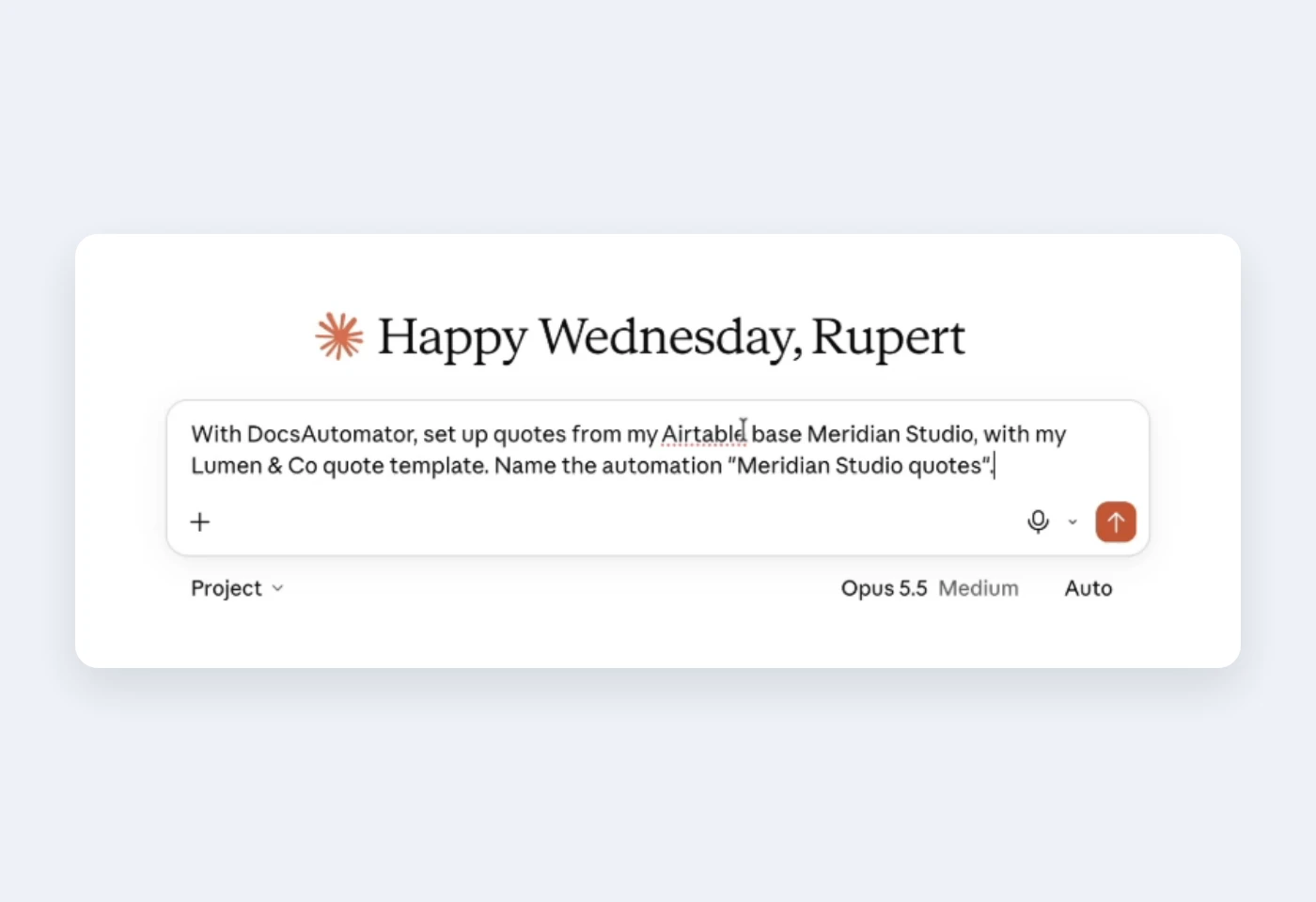
Add DocsAutomator and tell your AI app what you need
With DocsAutomator, set up quotes from my Airtable base Meridian Studio, with my Lumen & Co quote template. Name the automation "Meridian Studio quotes".
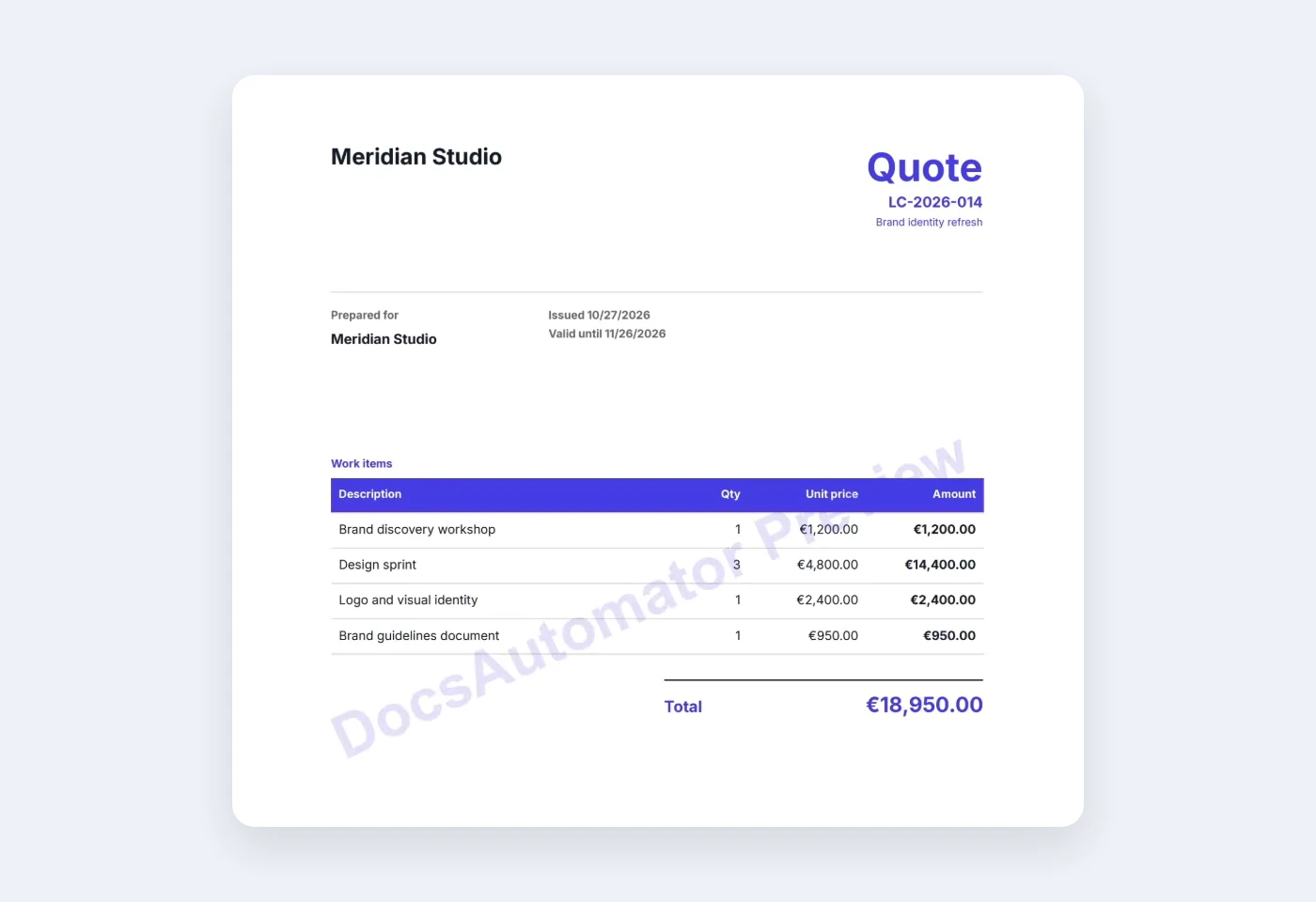
Check a free test document
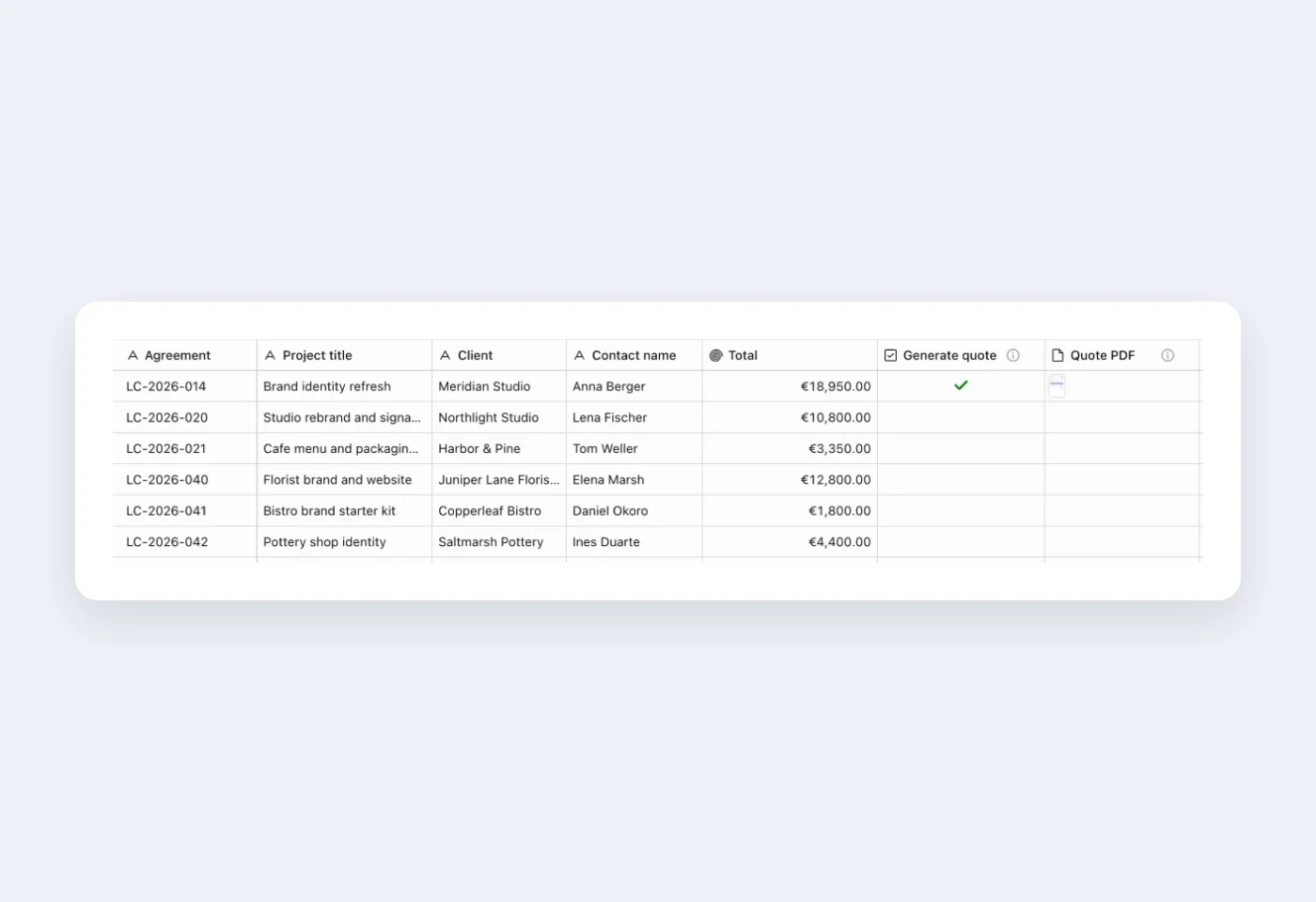
Go live: a checkbox in Airtable makes each quote
Learn more in our Knowledge Base
Start automating & signing in minutes!
Use Cases
Popular ways teams use AI & Agents
AI-Powered Contract Generation
Tell your AI assistant: "Create a service agreement for Acme Corp, $50k annual, starting April 1." The AI generates the contract from your template, and can send it for signing if you want.
Developer Workflow Automation
Use DocsAutomator's MCP tools inside Cursor or Claude Code to generate project documentation, invoices, or reports without leaving your development environment.
Autonomous Document Agents
Build AI agents that monitor data sources and generate documents autonomously. When a deal closes in your CRM, the agent generates the contract from your template, and can send it for signing.
Conversational Reporting
Ask your AI: "Generate this month's sales report and email it to the leadership team." The AI pulls data, generates the report, and triggers email delivery through MCP tools.
and many more...
Customer Voices
Don't take our word for it. Here's what our customers say about us:
DocsAutomator has been a game-changer for our company when it comes to creating documents both internally and for our clients. The tool's ease of use has made it simple for us to design documents without the need for technical expertise.

Jesús Gazca
I was looking for a convenient solution to generate Google docs based on Airtable data, which supported features like Line Items and Dynamic Folder Creation. I was thrilled to find DocsAutomator, the experience and support has been excellent.
Doug H.
DocsAutomator has helped our company tremendously with invoice issuing automation. We use Airtable and built-in extensions there have many limitations that prevented us from creating beautiful informative invoices.

Viktor Ivanov
CEO, ViktorLaw
DocsAutomator has decreased the amount of time I spend making the repeatable and batch documents I need for my business. [...] It's easy to set up and a very user friendly no code tool. Plus they are always making improvements. Love it.
Patrick Beseda
DocAutomator has helped my business automate invoices, contacts, and quarterly reports for our clients. This product saves us a lot of time, allowing us as a property management company to focus more on asset management.
Eran
I wonder why I lost so much time using page designer on Airtable. This is the best solution for regarding functionality, ease of use and price. I definitely recommend is. It s a no brainer - really! He also offers precise and super fast support!

Florence Bouchat
Why agents need a document tool
Agents are powerful, but "mostly right" isn't good enough for invoices, contracts, or anything that goes to a customer, regulator, or accountant. Here's what changes when the agent calls DocsAutomator instead of rendering a document itself.
AI models never answer the same way twice: useful for most things, risky for documents that must follow the same layout every time. A template fixes the layout, numbering, tax IDs and legal footers; only the data varies.
A generic "make a PDF" tool asks the agent to reason about your schema. DocsAutomator already knows Airtable's linked records, SmartSuite's nested fields, ClickUp's tasks, and Google Sheets' ranges. Real records in, real documents out, with no invented line items.
Generating a 4-page proposal from scratch per run burns tokens, seconds, and money. Filling a template is near-zero LLM work and milliseconds. At 5,000 docs/month the math isn't close, and your compliance team is far happier when every document traces back to a reviewed template.
A generated PDF is half the job. DocsAutomator handles the rest in the same agent call: save to Drive, email with conditions, send for legally binding e-signature, track completion, fire webhooks. One primitive, one conversation.

Start automating & signing in minutes!
AI Agents + Any Data Source













Frequently Asked Questions
mcp.docsautomator.co/mcp. Then sign in to DocsAutomator. No local server, no Docker, no npm packages.Start automating & signing in minutes!
Explore more features
Everything you need for document automation
AI Template Generator
Describe a document and let AI create a professionally designed Word (.docx) template for you.
Google Docs Templates
Build templates in Google Docs, one of the most intuitive document tools on the web.
Word Templates
Upload a Microsoft Word .docx template and generate Word or PDF documents from your data.
E-Signatures
Send documents from your data for signature or one-click acceptance.
Email Automation
Generate documents and email them as PDF attachments automatically.
Dynamic Line Items
Handle invoices, reports, and itemized lists with dynamic line items including nested data.
Conditional Logic
Show, hide, or style content conditionally based on your data.
AI Field Mapping
Map or generate sample data in seconds with the help of AI.
PDF Generation & Delivery
Generate PDFs, save to Google Drive, OneDrive or Dropbox, send via email, or trigger webhooks.
Batch Processing
Generate dozens of documents in parallel with queue-based batch processing.
REST API
Generate documents programmatically with sync/async modes and webhooks.
Trusted by teams who automate their documents:







A repeatable process for your documents, started from where your data lives, or from the chat.
Your template, your data, a repeatable process. Trusted by 1,215 businesses.
Unlimited testing, no credit card required